
Every year, a handful of quiet tools go from niche to normal without much fanfare. The IG profile viewer is having exactly that kind of moment right now. Not a viral feature, not a headline-grabbing launch, just a steady climb in everyday use that’s worth actually paying attention to. Nobody wrote a big product announcement about it. It just started showing up more, in more contexts, for more reasons than it used to.
The Six Trends at a Glance
| Trend | What’s Changing | Why It Matters |
| Two browsing speeds | Slower, deliberate browsing splitting off from fast-scroll habits | People want a mode Instagram’s feed was never built to offer |
| Desktop comeback | More lookups happening on bigger screens | Comparison and research work better with more screen space |
| Curiosity normalized | Looking someone up carries no stigma anymore | Ordinary curiosity now has an ordinary tool attached to it |
| Personal meets professional | Marketers, business owners, and recruiters use it too | The use case has broadened well past casual browsing |
| Simplicity wins | Cluttered tools losing ground to clean, fast ones | Patience for unnecessary features is running low |
| Novelty has faded | Using one no longer feels notable | A sign of genuine staying power, not a passing spike |
Trend One: Browsing Has Split Into Two Speeds
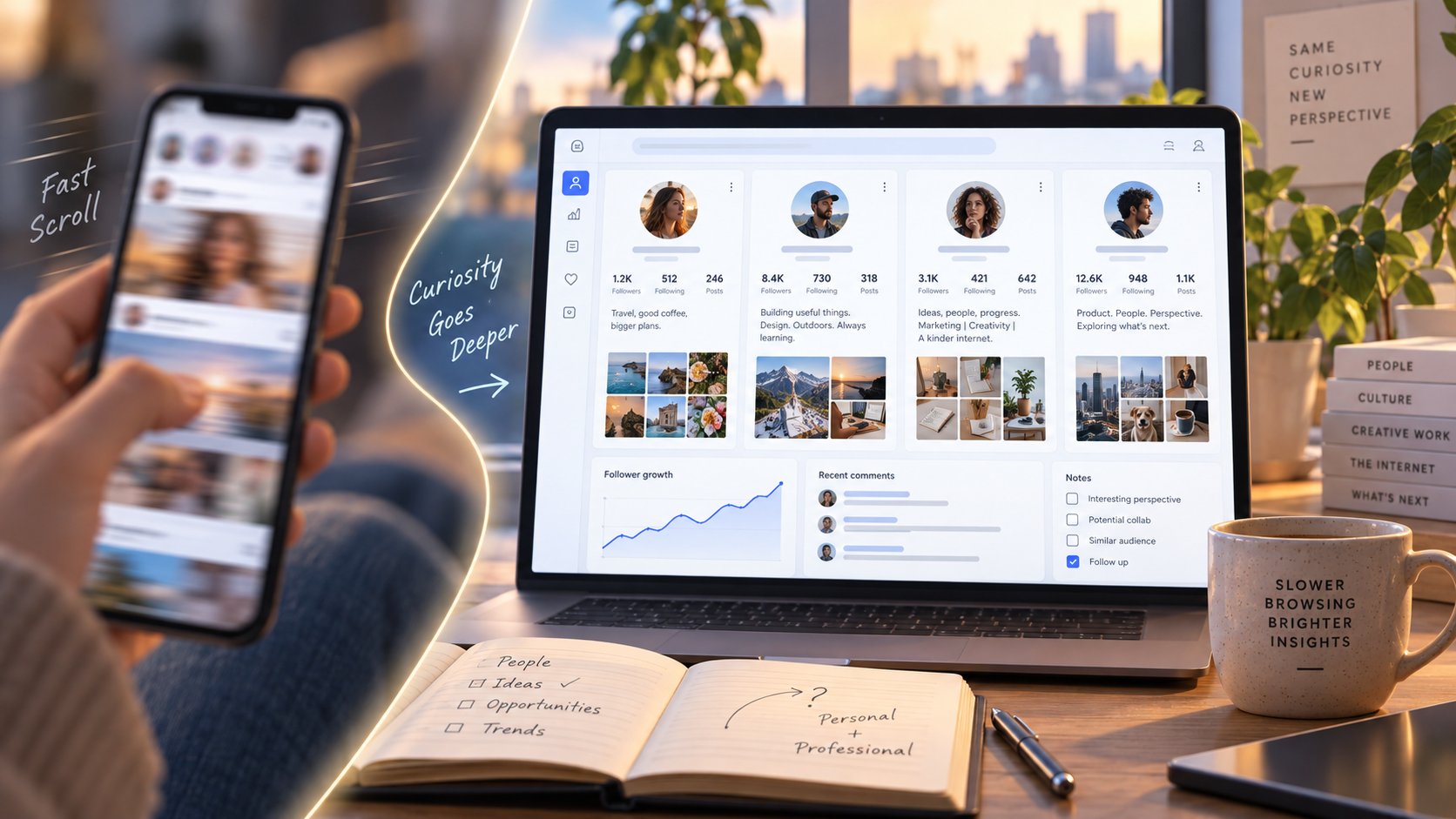
Instagram itself is built for one speed: fast, reactive, scroll-and-go. But a growing chunk of how people actually want to browse doesn’t match that pace anymore. Comparing profiles, researching a creator, looking something up out of simple curiosity, all of that benefits from slowing down, and the app’s own interface doesn’t really support it. The feed is designed to keep moving, not to let you linger on any one profile for long.
An IG profile viewer fills that gap by design. Open a browser tab, pull up a profile, take your time. No autoplay pulling your attention somewhere else, no algorithm nudging you toward the next thing. That deliberate, slower mode of browsing is becoming its own distinct habit, separate from the quick-scroll mode most people default to on their phone.
Trend Two: Desktop Is Quietly Making a Comeback
For years, mobile was simply assumed to be where Instagram happened. That assumption is cracking a little. More people are pulling up an IG profile viewer specifically to browse on a bigger screen, laptop, desktop monitor, even a tablet propped up at a desk. It’s a quiet reversal of a trend that seemed permanent just a few years ago.
The appeal isn’t complicated. Comparing several profiles side by side works better with more screen space. For research that involves reading discussions beneath posts, an Instagram comment viewer for profile research can also be useful, especially when working from a desktop browser. Reading captions and comments is easier without constant thumb-scrolling. For anyone doing this kind of browsing as part of actual work, research, content planning, competitive checks, desktop just makes more sense than squinting at a phone. Whole categories of research that used to happen awkwardly on mobile are moving back to a bigger screen simply because it’s the more comfortable place to do them.
Trend Three: Curiosity Browsing Has Gone Mainstream
There used to be a mild stigma around looking someone up online, like it needed a good excuse attached. That stigma has mostly faded. Checking out a profile before a first date, before a job interview, before deciding whether to follow a new creator, none of that raises eyebrows the way it might have a few years ago. It’s just become part of how people gather basic context before a decision.
An IG profile viewer fits neatly into that normalized curiosity. It’s a quieter way to look something up without it turning into a whole event, no follow request, no notification, no algorithm remembering you were there. Ordinary curiosity, ordinary tool, and increasingly, nobody thinks twice about either.
Trend Four: The Line Between Personal and Professional Use Is Blurring
What started as a mostly personal habit, checking on friends, looking at public figures, has increasingly bled into professional territory. Marketers use an IG profile viewer to scope out potential partnerships. Small business owners check what competitors are posting. Recruiters occasionally glance at a public portfolio account before an interview.
None of this is new exactly, but the volume has shifted. What used to be an occasional, almost incidental use case is turning into a genuine part of how a growing number of people approach research, whether that research is personal or tied to actual work. The tool didn’t change. What changed is how many different reasons people now have for reaching for it.
Trend Five: Expectations Around Simplicity Are Rising
As more tools in this space compete for the same audience, the ones surviving longest tend to share one trait: they stay simple. A username in, a clean result out. The IG profile viewer sites weighed down with unnecessary features, aggressive ads, or confusing navigation are losing ground to ones that just do the basic job well.
That shift toward simplicity says something about where user patience actually sits right now. People trying an IG profile viewer for the first time aren’t looking for a dashboard full of options. They’re looking for a fast, honest answer to one question, and the tools respecting that are the ones people stick with. It’s a pattern showing up across plenty of other corners of the internet too, less is increasingly winning against more, at least when the core function is this narrow to begin with.
Trend Six: The Novelty Has Worn Off, and That’s a Good Sign
A few years ago, mentioning an IG profile viewer might have prompted a raised eyebrow, like it was something slightly illicit or at least a little unusual. That reaction has largely disappeared. Using one now reads about as notable as using a search engine to look something up, which is to say, not notable at all.
That shift toward normalcy is worth paying attention to on its own. Tools tend to either fade out once the novelty wears off or settle into genuine, boring utility. This one has clearly landed in the second category, which is usually a better sign of staying power than any spike in attention ever was.
What’s Actually Driving All This
So what’s actually behind all six trends at once? Pull them apart and a common thread runs underneath: people want more control over how they browse, on their own terms, at their own pace, without the app dictating the experience.
A few things are converging at the same time:
- Instagram’s own interface is optimized for speed, not for research or careful comparison
- More of daily life, work and personal, now runs through a browser rather than a single app
- Tolerance for unnecessary friction, extra steps, ads, logins, has dropped across the board
- Curiosity-driven browsing has lost whatever stigma it used to carry
Instagram wasn’t built around that kind of control, and an IG profile viewer, in its modest way, hands a little of it back.
None of this points toward some dramatic platform shift. It’s smaller and steadier than that, a gradual redirection of ordinary browsing habits toward tools that respect a slower, more deliberate pace. That’s usually how real trends actually work, not with a bang, but with millions of small, quiet decisions pointing the same direction over time. Nobody sets out to change a habit dramatically. It just accumulates, one convenient tool at a time, until the old default doesn’t feel like the only option anymore.
There’s a broader pattern here too, one that extends past Instagram specifically. Plenty of platforms built around fast, reactive engagement are quietly losing ground to slower, more deliberate ways of interacting with the same content. Read-it-later tools, RSS readers making a modest comeback, browser extensions that strip feeds down to something calmer. An IG profile viewer belongs in that same family, a small tool built for people who want to opt out of the pace a platform assumes everyone wants, at least some of the time.
Where This Goes Next
So where does all this actually land? If the current trajectory holds, expect the line between “official Instagram browsing” and “browsing through a dedicated viewer” to keep blurring rather than sharpening. People increasingly don’t think of these as separate categories, just different windows onto the same content, chosen based on whatever moment calls for it.
The IG profile viewer isn’t replacing Instagram, and it was never trying to. It’s carving out the specific, deliberate corner of browsing that the app itself was never really built to handle, and based on where these six trends are heading, that corner isn’t shrinking anytime soon.
What’s worth watching next is whether the tools themselves start converging on a shared standard for what “good” looks like in this space, fast, simple, honest about their limits, or whether the current fragmentation continues, with dozens of near-identical sites competing on marginal differences nobody outside the category much notices. Either way, the underlying behavior driving all of it, people wanting a slower, more deliberate way to browse on their own terms, isn’t going anywhere.